Everyone is talking about the big A, "L'Antipolitica". It started with Beppe Grillo's "vaffa" day and doesn't seem to go away.
Today, Ezio Mauro, the Director of la Repubblica newspaper wrote an editorial entitled, "Anti-politics, for Whom the Bell Tolls", which is a bit rhetorical as it goes on about the "decadence of the country...and the loss of cultural identity" before exploring how this has led Italians away from change and towards rebellion, as if,"Changing Italy was an impossible task, or worse, a useless one." He cites the static quality of the political class as leading Italy into, "An atelier of the West, or a home for its elderly." The Antipolitica is just "an outward sign of a diminishing public and national spirit, a lost sense of citizenship, identity, cultural reference point."
Not an uplifting editorial and really not a very thoughtful one either. I think I have already heard all this. Blablabla.
Instead, a few days ago, I read another editorial -- train rides are condusive to this kind of activity -- one by Sandro Viola, called "What Feeds Anti-politics." This was more interesting. He first acknowledged that while there has been lots of talk, no one wants to dig deeper to the roots of the problem. He instead addresses the role of the media in the Italian people's growing sense of nausea at all that smells of politics. At the top of the list are the TV news programs, so full of comprimises, starting with the practice of "the sandwich" (they actually call it "sandwich" as the practice has Anglo-saxon roots). First politicians from the governing party speak (or have their declarations read) for a pre-set number of minutes, followed by those from the opposition, finishing up with a summary by the governing party's spokesperson. The end result, Sandro Viola calls, "fried air, an avalanche of words." So we see the same faces, every evening, year in and out, that do nothing but repeat the same empty phrases. "The Italians need air," he concludes, "they can't breathe anymore. They don't want to see or hear these people anymore."
The newspapers are not much better as they put out an average of seven or eight pages dedicated to internal "news", of which only one or two pages are of any pertinence or interest to the public. The rest is a repeat of the TV news programs -- detailed analysis of every empty phase pronounced the night before, long declarations, interviews that go on and on. In other words, a dialogue between journalists and politicians with no distinction between what is relevant and what is not. The Italian people are exasperated by this deluge of nothing and have developed an allergy to all that tastes of politics.
The Italian people, he concludes, are no longer divided between "us" and "them" (as in left and right political leanings) as had been the case for over a hundred years. Now, previous enemies march together in disgust of what they see on both sides, while chanting Bebbe Grillo's slogans, abandoned not only by the political system, but also by the media.
Anyone want to rally Italians to a nation-wide TV strike? Maybe for a week or even a month. Where is Beppe when we need him? I know you don't get to hang out in the piazza with your friends or throw a walking street party as you do with a normal style strike and demonstration, but you would get to read a few good book. I read Suite Francese by Irène Némirovsky for the September meeting of my book club and I am halfway through Terrorist by John Updike for the October meeting -- both qualify as a good read. Why not just turn off the traitor and tool of political jibberish and cuddle up with a book.
a domani,
E
September 27, 2007


September 22, 2007
Beauty contests
The Miss Italia contest is always a bit depressing to watch, but this year was especially bad, so bad that even Walter Veltroni (Rome's mayor and candidate as leader of the "partito democratico") couldn't hold his tongue. Here is a translation:
"I turned on the TV and I said,"Mamma mia". I asked myself if it wasn't "Schegge" (a program that shows clips of TV programs from 20-30 years ago).....This is a backward looking country, a country that doesn't want to change and where there is a strong prevalence of experience over innovation."
Resistence to change both maintains and enhances traditions, and hinders innovation. School reforms are under discussion, again, but reforms do not take place. Political reforms are under discussion, again, but reforms do not take place. Beauty pagent reforms are under discussion, again -- change is scary, it takes optimism, risks, willingness to see things in a new way, open-mindedness and the willingness to change again if the change doesn't work out. Better to keep things as they are. There is a saying that "the evil that you know is better than the evil you do not know." Just hunker down, complain, endure and do nothing that will actually enact change. Maybe throw a street party in the form of a demonstration just to make yourself feel like you have done something.
If you didn't like the Miss Italia pagent, you could always change channels and watch more scantily-dressed women, this time "show-girls" on the talk show, "Porta a Porta", taking about female orgasms.
a domani,
E
"I turned on the TV and I said,"Mamma mia". I asked myself if it wasn't "Schegge" (a program that shows clips of TV programs from 20-30 years ago).....This is a backward looking country, a country that doesn't want to change and where there is a strong prevalence of experience over innovation."
Resistence to change both maintains and enhances traditions, and hinders innovation. School reforms are under discussion, again, but reforms do not take place. Political reforms are under discussion, again, but reforms do not take place. Beauty pagent reforms are under discussion, again -- change is scary, it takes optimism, risks, willingness to see things in a new way, open-mindedness and the willingness to change again if the change doesn't work out. Better to keep things as they are. There is a saying that "the evil that you know is better than the evil you do not know." Just hunker down, complain, endure and do nothing that will actually enact change. Maybe throw a street party in the form of a demonstration just to make yourself feel like you have done something.
If you didn't like the Miss Italia pagent, you could always change channels and watch more scantily-dressed women, this time "show-girls" on the talk show, "Porta a Porta", taking about female orgasms.
a domani,
E
September 21, 2007
Divorce and all that
It is very difficult to objectively and lovingly examine one’s own culture. Luigi Barzini is the only Italian that has done it successfully, while adding wit, historical background and journalistic accuracy.
His book, The Italians, published in 1964, is still the only true examination of Italian culture that exists today. If you are thinking of moving to Italy, you already have or are just interested in the Italians as a people, this is the book to read.
He made one big mistake, though, near the end of the chapter, Power of the Family. “Divorce is beginning to be adopted as an upper-class custom. Of course there is still no divorce on the law books, and there never will be. Not only is the Church against it, but the people themselves rightly consider it a barbarous and ruinous institution; the necessity to preserve some solid bulwark against the impermanence of things will always prevent its adoption.”
Instead, only eight years later, divorce came to be -- despite the war waged by the Catholic church -- by “furore del popolo” and a public referendum.
Between 1995 and 2005, separations have gone from 51,000 to 83,000, divorces from 27,000 to 47,000. Although Italy doesn’t come close to European standards, or American ones in which 50% of marriages end in divorce before reaching 25 years, separations have become more democratic. They no longer involve only the upper class, which means that more couples that separate end up in poverty.
With an Italian twist. In a country where the family supplies “welfare” instead of the state, one in five separated men go back home, to their parents' home – the only way to afford alimony and a another roof over their head – and yet another example of intra-generational solidarity and family ties. Luigi Barzini was right – “The first source of power is the family. The Italian family is a stronghold in a hostile land: within its walls and among its members, the individual finds consolation, help, advice, provisions, loans, weapons, allies and accomplices to aid him in his pursuits. No Italian who has a family is ever alone.”
A domani,
E
His book, The Italians, published in 1964, is still the only true examination of Italian culture that exists today. If you are thinking of moving to Italy, you already have or are just interested in the Italians as a people, this is the book to read.
He made one big mistake, though, near the end of the chapter, Power of the Family. “Divorce is beginning to be adopted as an upper-class custom. Of course there is still no divorce on the law books, and there never will be. Not only is the Church against it, but the people themselves rightly consider it a barbarous and ruinous institution; the necessity to preserve some solid bulwark against the impermanence of things will always prevent its adoption.”
Instead, only eight years later, divorce came to be -- despite the war waged by the Catholic church -- by “furore del popolo” and a public referendum.
Between 1995 and 2005, separations have gone from 51,000 to 83,000, divorces from 27,000 to 47,000. Although Italy doesn’t come close to European standards, or American ones in which 50% of marriages end in divorce before reaching 25 years, separations have become more democratic. They no longer involve only the upper class, which means that more couples that separate end up in poverty.
With an Italian twist. In a country where the family supplies “welfare” instead of the state, one in five separated men go back home, to their parents' home – the only way to afford alimony and a another roof over their head – and yet another example of intra-generational solidarity and family ties. Luigi Barzini was right – “The first source of power is the family. The Italian family is a stronghold in a hostile land: within its walls and among its members, the individual finds consolation, help, advice, provisions, loans, weapons, allies and accomplices to aid him in his pursuits. No Italian who has a family is ever alone.”
A domani,
E
September 14, 2007
Coffee culture
 Seattle skyline, home to Starbucks
My Dad wrote that the Stop 'n Shop supermarket in West Hartford, Connecticut has opened a Starbucks' bar for customer convenience inside the store. To promote it's opening, they were offering pumpkin spice latte and chocolate chip coffee.
Why? Sounds disgusting and really has nothing to do with coffee, that strong bitter zing that we know and love, but Americans, instead, love anything new and different and having lots of choice -- even at the expense of a good cup of coffee -- the more flavors and options, the better.
The Italians would rather just have a good cup of coffee -- quality over choice. Although they can get rather picky about whether it is served long or short, in a cup or a glass, with or without a drop of cold or hot milk and such, tasting the quality of the coffee itself is the point.
The man behind the counter at a local bar, across the street from an American study abroad center, confided one day that he could not understand why the students were always asking to create their own sandwich combinations instead of being satisfied with the standard ones on display. "These are the best combinations that have filtered down over generations: tomato and mozzarella, tonno e carciofini, ham and cheese, bresaola e rughetta." Sacrificing a tasty sandwich to the altar of "choice" was way outside of his cultural code.
Choice and trying new things is at the top of the American value scale, anything new is intrinsically better. Sometimes this leads to innovation and other times simply to bad taste, like pineapple and chicken on pizza.
 Guy with cowboy hat hanging at Starbucks.
We stopped in a Starbucks while on a one-day layover in Seattle this summer. My sons, being Italian, were diffident at and overwhelmed by all the crazy combinations on the board and nearly ordered a regular coffee. But the waitress (very cute and just their age) said, "How boring, you must try something flavored." So they did (one with hazelnut and another with vanilla and something) and after a few sips of the sweet and sticky liquid, threw it out.
We stuck to regular coffee for the rest of the trip.
a domani,
E
September 10, 2007
City lights

My night photography skills need some work.... but in any case, if you are in Rome, stop by the Circo Massimo after 10:00 pm to view the light show before it closes tomorrow --- fantastic (or as the guy standing next to me said to someone on the other end of his cell phone, "una ficata.")
La Notte Bianca came and went, 250 tons of trash have been removed and only the lights at Circo Massimo are left.
40,000 attended the 6:00am concert by the Italian group "Zero Asoluto", another 10,000 watched a ritual dance by a Turkish Sufi group of whirling dervisces at the same time with the sunrise as a backdrop from the Gianicolo hill. 100,000 visited the zoo, another 100,000 watched a circus performance in Piazza del Popolo and 20,000 visited the newly re-opened Palazzo delle Esposizioni. There were long lines for all the museums and 10,000 visited inside the historic building that houses the Ministry of Economics. 730,000 people used the buses to get around, with the center closed off to traffic.
An estimated 2.5 million people participated with only 145 emergency interventions, none serious.
The Romans certainly know how to throw a great party, everyone had fun and no one got hurt. Do we have something to learn from this?
a domani,
E
September 8, 2007
La notte bianca
Big night ahead. La notte bianca. From the historic center to the parks, EUR, San Lorenzo, the Flaminia -- the city will be awake and alive with music, light shows, art, theater, dance, poetry readings and more until dawn. Museums will be open and ministerial offices will flaunt their secret treasures. Piazzas will serve as stages alongside the auditorium. Over 2 million people of all ages are expected to participate.
It is magical -- masses of people strolling along, arm in arm just admiring the city, the lights, the sounds, the experience.
What is striking, for an American, is the lack of control, fear, containment. No barricades, the police are discrete, no gangs, no violence. Just a special evening for all to enjoy. A salute to the summer. A grand welcome back to the city before the grit and traffic wears on the spirit.
In its first edition, five years ago, the white night became black as the largest country wide power black-out just happened to take place at 2:30 am that night. Masses of people were stranded on the city streets in the dark. The buses couldn't run, nor the trams. But no one panicked, no shops were sacked, no violence occurred. The Romans walked home, or enjoyed the rest of the night in company and waited until dawn. The Italian, "che si puo fare" resignation sometimes works wonders.
a domani,
E
La Notte Bianca web site for information
It is magical -- masses of people strolling along, arm in arm just admiring the city, the lights, the sounds, the experience.
What is striking, for an American, is the lack of control, fear, containment. No barricades, the police are discrete, no gangs, no violence. Just a special evening for all to enjoy. A salute to the summer. A grand welcome back to the city before the grit and traffic wears on the spirit.
In its first edition, five years ago, the white night became black as the largest country wide power black-out just happened to take place at 2:30 am that night. Masses of people were stranded on the city streets in the dark. The buses couldn't run, nor the trams. But no one panicked, no shops were sacked, no violence occurred. The Romans walked home, or enjoyed the rest of the night in company and waited until dawn. The Italian, "che si puo fare" resignation sometimes works wonders.
a domani,
E
La Notte Bianca web site for information
September 7, 2007
September
I've returned to blogging. An official re-entry from the summer.
The trouble with August is that then September comes around. Soon the newspapers will have articles on "September-itis", the annual bug that attacks as everyone goes back to work, study and daily life with another eleven months ahead before August comes around again.
The symptoms include low grade depression, lack of energy, difficulty in getting up in the morning, difficulty in getting to sleep in the evening. The cure is to rest, eat lightly and get back into your routine slowly while allowing time for a walk in the park, a stroll and an ice cream, a chat with a friend. Diving headfirst into a frenetic rhythm is not recommended.
So September starts out slowly, con calma. It is the provisional month -- everything is provided for the time being, pending permanent arrangements.
Summer is over. Families return from the beach or the mountains and while parents slowly get back to their work routines, children finish summer homework under the watchful eyes of grandparents or nannies. The annual September dance begins as everyone engages in the process of moving all that is provisional to its final rest. When I call the doctor to change an appointment, the secretary assures me, “It’s September, we understand.” Everyone understands that arrangements, calendars, schedules and appointments will be provisorio for the interim month that separates the August holiday break from the rest of the year. Then October arrives, the pieces fall into place and the year takes form.
School starts. Early in the month national newspapers and television announce the official starting dates as dictated by the Ministry of Public Instruction. The Ministry establishes these dates by region, the schools in the north start around September 8 or 10, those in the center around mid-month and Sicilian schools start as late as September 25. With the last reforms, individual schools have some administrative flexibility, called autonomia, and they often exercise this new freedom by adjusting the regional starting date to meet particular needs. These dates are then kept a secret from students and parents. The school website gives only its long and illustrious history, not pragmatic information such as the first day of classes. The office is open only three mornings a week and the staff is so busy with enrolling students that the phone rings unanswered.
But the word gets out anyway, in that particular Italian way so that everyone just "knows" although never through official channels. A few years ago, the school suddenly decided that it would open a few days earlier than anticipated. Within minutes, the news had spread down the beach from lounge chair to lounge chair. Parents re-arranged plans, cancelled last minute weekend trips and liberated grandparents from additional days of babysitting. I found it amazing that no one seemed particularly annoyed by this uncertainty, it is just part of the September game – flexibility is the only rule.
During the first days of school, teachers dictate class schedules that children carefully pencil into their new diari -- the colorful agendas will hold a year’s worth of homework assignments, notes from teachers to parents and most importantly student to student correspondence. Although they may seem quite official, these first class schedules will change a few more times before they can be set in pen – sometime in October.
My agenda is starting to fill up for September, in pencil. My pen will have to wait until October.
a domani,
E
P.S. I have recently posted an interview on an expat interview site.
I also just saw that my article on the American expat community published in The Roman Forum July 2007 issue is online.
The trouble with August is that then September comes around. Soon the newspapers will have articles on "September-itis", the annual bug that attacks as everyone goes back to work, study and daily life with another eleven months ahead before August comes around again.
The symptoms include low grade depression, lack of energy, difficulty in getting up in the morning, difficulty in getting to sleep in the evening. The cure is to rest, eat lightly and get back into your routine slowly while allowing time for a walk in the park, a stroll and an ice cream, a chat with a friend. Diving headfirst into a frenetic rhythm is not recommended.
So September starts out slowly, con calma. It is the provisional month -- everything is provided for the time being, pending permanent arrangements.
Summer is over. Families return from the beach or the mountains and while parents slowly get back to their work routines, children finish summer homework under the watchful eyes of grandparents or nannies. The annual September dance begins as everyone engages in the process of moving all that is provisional to its final rest. When I call the doctor to change an appointment, the secretary assures me, “It’s September, we understand.” Everyone understands that arrangements, calendars, schedules and appointments will be provisorio for the interim month that separates the August holiday break from the rest of the year. Then October arrives, the pieces fall into place and the year takes form.
School starts. Early in the month national newspapers and television announce the official starting dates as dictated by the Ministry of Public Instruction. The Ministry establishes these dates by region, the schools in the north start around September 8 or 10, those in the center around mid-month and Sicilian schools start as late as September 25. With the last reforms, individual schools have some administrative flexibility, called autonomia, and they often exercise this new freedom by adjusting the regional starting date to meet particular needs. These dates are then kept a secret from students and parents. The school website gives only its long and illustrious history, not pragmatic information such as the first day of classes. The office is open only three mornings a week and the staff is so busy with enrolling students that the phone rings unanswered.
But the word gets out anyway, in that particular Italian way so that everyone just "knows" although never through official channels. A few years ago, the school suddenly decided that it would open a few days earlier than anticipated. Within minutes, the news had spread down the beach from lounge chair to lounge chair. Parents re-arranged plans, cancelled last minute weekend trips and liberated grandparents from additional days of babysitting. I found it amazing that no one seemed particularly annoyed by this uncertainty, it is just part of the September game – flexibility is the only rule.
During the first days of school, teachers dictate class schedules that children carefully pencil into their new diari -- the colorful agendas will hold a year’s worth of homework assignments, notes from teachers to parents and most importantly student to student correspondence. Although they may seem quite official, these first class schedules will change a few more times before they can be set in pen – sometime in October.
My agenda is starting to fill up for September, in pencil. My pen will have to wait until October.
a domani,
E
P.S. I have recently posted an interview on an expat interview site.
I also just saw that my article on the American expat community published in The Roman Forum July 2007 issue is online.
August 27, 2007
driving lessons
With his driving permit in hand my son has been driving me to and from volleyball practice near the via Flaminia. Until today, there were so few cars on the road that it was a reasonable ride.
But now they are back, Roman drivers, driving on the same Roman streets that have turned overnight into chaos. I try to encourage my son to stay within one of the three lanes while cars weave back and forth, "what lanes?", he asks and in fact, they are not marked on the road. Then I tell him not to even consider overtaking the bus in front of us on the via del Gianicolo that winds its way up the Gianicolo hill curve after curve. As I speak, a red Panda overtakes us just before a curve and sneaks in behind the bus into what was his safety distance. "Like that", I add.
As I have noted before here, it is about a different sense of personal space, in-groups to which you, as a mere stranger, never belong and a ever changing personalized interpretation of rules.
Today it all rubs me the wrong way. I've been away. Or maybe it is the heat.
1. A bus slowly wanders into the intersection past a red light while its driver chats on his cell phone. Will it stop and do I dare pass? I flash. He looks at me, surprised, "what do you want from me?"
2. Guy behind me in a big fat car on a quiet side street in Monte Verde Vecchio hugging the back of my car and flashing his lights. I roll down the window and indicate "slow down" and another "che fai" signal. 50km is more than enough in this neighborhood. He gave me the finger as I turned off at the next intersection and raced off.
3. One line, five people stand and wait. New window suddenly opens. Woman rushes in the front door and runs to the window. "Excuse me", I intervene, "We have all been waiting." She looks astonished. What could I possibly be talking about. "But a new window has opened," she states as she turns to do her operation. No one says anything, like "hey lady, get to the back of the line," instead they look down, embarrassed for me.
4. Two young girls (maybe 17) walking their dog. They stop. He has to poop. That done, they wander off enveloped in chatter. Since the tree where he stopped is just by my door, I pull over, roll down the window and ask, "and you just walk off, like that?" One girl stops, "excuse me?" I continue, "Your dog finishes and then you just walk off?" She looks confused, has no idea what I am talking about. So, I got specific, "the dog pooped and you just left it there and walked off." A glitter of awareness began to shine, "oh, that, but it was on the dirt." So, while the rule is, "pick up your dog's poo," her personal interpretation is that this rule does not apply if the poop lands in the small circle of dirt cut into the sidewalk to make room for the tree's roots. Good to know should I ever have a dog.
Yep. I'm back. In the extreme heat, with no extreme air conditioning and no public pool in sight. The hotel nearby wanted 40 euros a person yesterday to partake of their waters. Significantly more than our day at Universal Studios!
a domani,
E
But now they are back, Roman drivers, driving on the same Roman streets that have turned overnight into chaos. I try to encourage my son to stay within one of the three lanes while cars weave back and forth, "what lanes?", he asks and in fact, they are not marked on the road. Then I tell him not to even consider overtaking the bus in front of us on the via del Gianicolo that winds its way up the Gianicolo hill curve after curve. As I speak, a red Panda overtakes us just before a curve and sneaks in behind the bus into what was his safety distance. "Like that", I add.
As I have noted before here, it is about a different sense of personal space, in-groups to which you, as a mere stranger, never belong and a ever changing personalized interpretation of rules.
Today it all rubs me the wrong way. I've been away. Or maybe it is the heat.
1. A bus slowly wanders into the intersection past a red light while its driver chats on his cell phone. Will it stop and do I dare pass? I flash. He looks at me, surprised, "what do you want from me?"
2. Guy behind me in a big fat car on a quiet side street in Monte Verde Vecchio hugging the back of my car and flashing his lights. I roll down the window and indicate "slow down" and another "che fai" signal. 50km is more than enough in this neighborhood. He gave me the finger as I turned off at the next intersection and raced off.
3. One line, five people stand and wait. New window suddenly opens. Woman rushes in the front door and runs to the window. "Excuse me", I intervene, "We have all been waiting." She looks astonished. What could I possibly be talking about. "But a new window has opened," she states as she turns to do her operation. No one says anything, like "hey lady, get to the back of the line," instead they look down, embarrassed for me.
4. Two young girls (maybe 17) walking their dog. They stop. He has to poop. That done, they wander off enveloped in chatter. Since the tree where he stopped is just by my door, I pull over, roll down the window and ask, "and you just walk off, like that?" One girl stops, "excuse me?" I continue, "Your dog finishes and then you just walk off?" She looks confused, has no idea what I am talking about. So, I got specific, "the dog pooped and you just left it there and walked off." A glitter of awareness began to shine, "oh, that, but it was on the dirt." So, while the rule is, "pick up your dog's poo," her personal interpretation is that this rule does not apply if the poop lands in the small circle of dirt cut into the sidewalk to make room for the tree's roots. Good to know should I ever have a dog.
Yep. I'm back. In the extreme heat, with no extreme air conditioning and no public pool in sight. The hotel nearby wanted 40 euros a person yesterday to partake of their waters. Significantly more than our day at Universal Studios!
a domani,
E
August 25, 2007
August days
One thing I like about August days in Rome is the sense of intimacy. There are so few of us here and no one is in a rush. Only one bar is open in my neighborhood and there was a lively mixed crowd at the tables in front -- a happening place to be in the midst of boarded up shops, bars and restaurants where everyone stops and chats to strangers. I stopped by the market on my way home and found one lone stand open, an explosion of color between the large grey shuttered stands to either side. He was alone and greeted me with open arms -- "Ahhhhh bella signora, solo noi due qui oggi!"
I won't last long! The hoards will be filling the highways and byways tomorrow and by Monday we will just be among the crowds again.
a domani,
E
I won't last long! The hoards will be filling the highways and byways tomorrow and by Monday we will just be among the crowds again.
a domani,
E
August 22, 2007
Back from the USA
Back home. Heat. Absolute quite. Parking paradise.
It is August and everyone is still away.
But we are here. Juggling jet-lag, finishing off work upstairs with our Romanian workmen and shuffling our son back and forth to volley practice morning and afternoon while he navigates the empty city streets with his "foglio rosa" or driving permit.
Cross-cultural highlights from our US trip to Alaska and California.
Best air conditioning moment. Exiting the Fairbanks, Alaska airport into 50 degree (F) temperature with drizzle conditions only to enter a hotel shuttle van with blaring air conditioning -- a true cultural mystery. No oil shortage in Alaska for sure! Italians (and the rest of the world) will never, never understand the American obsession for extreme air conditioning.
Great signs telling us what to do and not to do: No diving into a hot tub?
 And why would you try to climb on top of an oil pipeline, unless you were really, really stupid?
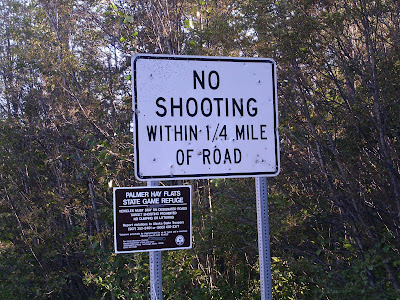 Notice the bullet holes? Guess that sign worked.
The food thing: just too much of it.
Mexican burritos for four (more like eight?).
Delta airline "snack" -- a choice of chips, granola bars (pure fats and sugar) or salted peanuts. First class got a wider variety of chips. How lucky!
Bus stop just outside Anchorage (tire blow) at 6:30. EVERYONE broke out the snack food, what else is there to do when a tire blows out but eat.
We had great food on our trip. Very often. No time interval to get hungry and the next meal was already on its way. We tried to have dinner at 10:00 in Santa Barbara, but at that hour you can only drink -- if you are over 21.
The drinking thing. My 18 and 19 year olds couldn't enter a bar with their 21 and 23 year old cousins even just to hear the band that was playing and have a coke....They all ended up hanging out in a hotel room instead. A great American experience, being carded and sent to hide out in a room. I suppose this produces responsible adults.
Organization: fantastic! Cruise West was the best, even under the stress of a tire blow-out. The timing, organization, attention to detail, customer service, care was amazing to watch -- American expectations in the sphere of customer service are indeed very high. We, instead, stood in awe as they catered to our every possible need.
Horizontal hierarchy: The captain, engineer, hotel manager were all there helping pass our luggage along up the plank together with their hard-working staff. Objective-driven teamwork at its best. No "barone" allowed, all for one and one for all. Almost shocking to watch.

Dryers: An Anchorage moment.
Nature: A Santa Barbara moment.
A domani,
E
It is August and everyone is still away.
But we are here. Juggling jet-lag, finishing off work upstairs with our Romanian workmen and shuffling our son back and forth to volley practice morning and afternoon while he navigates the empty city streets with his "foglio rosa" or driving permit.
Cross-cultural highlights from our US trip to Alaska and California.

Best air conditioning moment. Exiting the Fairbanks, Alaska airport into 50 degree (F) temperature with drizzle conditions only to enter a hotel shuttle van with blaring air conditioning -- a true cultural mystery. No oil shortage in Alaska for sure! Italians (and the rest of the world) will never, never understand the American obsession for extreme air conditioning.
Great signs telling us what to do and not to do:
 No diving into a hot tub?
  And why would you try to climb on top of an oil pipeline, unless you were really, really stupid?
 Notice the bullet holes? Guess that sign worked.
 The food thing: just too much of it.
Mexican burritos for four (more like eight?).

Delta airline "snack" -- a choice of chips, granola bars (pure fats and sugar) or salted peanuts. First class got a wider variety of chips. How lucky!
Bus stop just outside Anchorage (tire blow) at 6:30. EVERYONE broke out the snack food, what else is there to do when a tire blows out but eat.
We had great food on our trip. Very often. No time interval to get hungry and the next meal was already on its way. We tried to have dinner at 10:00 in Santa Barbara, but at that hour you can only drink -- if you are over 21.
The drinking thing. My 18 and 19 year olds couldn't enter a bar with their 21 and 23 year old cousins even just to hear the band that was playing and have a coke....They all ended up hanging out in a hotel room instead. A great American experience, being carded and sent to hide out in a room. I suppose this produces responsible adults.
Organization: fantastic! Cruise West was the best, even under the stress of a tire blow-out. The timing, organization, attention to detail, customer service, care was amazing to watch -- American expectations in the sphere of customer service are indeed very high. We, instead, stood in awe as they catered to our every possible need.
Horizontal hierarchy: The captain, engineer, hotel manager were all there helping pass our luggage along up the plank together with their hard-working staff. Objective-driven teamwork at its best. No "barone" allowed, all for one and one for all. Almost shocking to watch.


Dryers: An Anchorage moment.

Nature: A Santa Barbara moment.

A domani,
E
Subscribe to:
Posts (Atom)

 Posts
Posts

