I just received an invitation to a film event on Tuesday to recognise and celebrate the UN's decision to back the Italian call for a global moratorium on the death penalty.
During my last visit to my parents in Connecticut, I was sitting at the kitchen table, skimming the paper with a mug of American coffee in hand, when I noticed a letter to the editor against the death penalty. I thought about how much discussion goes on in US on the subject with strong forces arguing for and against it regularly in the public arena and the question of its implementation coming up over and over on political agendas. It suddenly hit me that this is a subject Italians never discuss -- it never comes up seriously on political agendas, and not even in the daily batter over your cappuccino at the bar. From the left to the right (excluding the farrrr right, who does raise the issue occasionally, only to have it quickly put in its place) the subject is taboo, the death penalty is not an option. punto e basta.
Catholic culture? Too many skeletons in the closet and hanging from the rafters (the shocking end to Mussolini)? Too many foreign rulers in Italy's past who used the gallows to maintain power? For whatever reason, the cultural roots in terms of values and beliefs are deep on both sides and the gap is wide. It would take a real shift in perspective for one to understand the other. Even those against the death penalty in the US accept that another position exists and that discussion is legitimate. That is the real difference -- here, all agree, across all political lines, that the subject is not even worthy of discussion.
In any case, the good news is that Connecticut is voting to take the death penalty off the books -- it hasn't been applied for over one hundred years anyway.
a domani,
E
Anyone in Rome that is interested, here is the information.
"In the spirit of collaboration the following organisations will be present: Nessuno Tocchi Caino, Comunita' S. Egidio, the Comitato Sacco e Vanzetti, Americans for Peace and Justice Abroad, the Comitato Paul Rougeau, and others.
There will be a screening of two short documentaries by La7 director Chiara Salvo, exploring the relationships between death row inmates and the Italians who correspond with them, who will be present, followed by an open forum for discussion of the next steps in the campaign.
When: Tuesday 29th January, 8.30pm
Where: Cineclub Detour, Via Urbana 44, metro Cavour"
Showing posts with label history. Show all posts
Showing posts with label history. Show all posts
January 27, 2008


December 16, 2007
History's roots
 I've been away for a few days traveling by ski trail between the Alto Adige and Trentino regions up North. In Trentino, we felt like we were in Italy, lift workers spoke Italian and there were more types of pasta than just spaghetti al ragù on the menu. When we passed over the border into Alto Adige, we felt like we had gone abroad, lift workers (and the Hotel) spoke German and the menu carried many sorts of wurstel. Although we were always in Italy, we had touched first hand the effects of History. This area has its roots somewhere between "high" Adige or "south" Tirol and although over half a century has passed since it is officially part of Italy, part of its soul lies elsewhere.
 a domani from Rome,
E
November 27, 2007
The power of history
We talked about the Italian Sense of History the other day as a dividing line between them and us, "being" and "doing", but where does it come from? In addition to the rich heritage left by ancient Roman philosophers, writers, politicians and orators, modern day Romans also inherited similar daily problems. As they say, "The more things change, the more they stay the same." How true!
Albero Angela, in a book being released today (in Italian), Una Giornata nell'antica Roma (A Day in Ancient Rome), outlines the eight major problems of Rome back then: traffic, noise, commuting time, street filth, housing crisis and high prices, unsafe buildings, uncontrolled immigration and nighttime security. The traffic was so bad that the ancient Romans even installed a sort of ZTL to keep private vehicles out of the center during the day and like today, certain high level public officials had the equivalent of the "auto blu" which they used to circulate not only for work, but also for pleasure. The via Appia and Ostiense were the equivalent of our train station area -- filled with immigrants on their way into the city from the ports of Ostia, Brindisi and Pozzuoli.
When you have been living with the same unresolved problems for nearly three thousand years, change is daunting. To be sure, you have tried it all before and obviously nothing has worked -- the same old problems just keep coming back. The flow of history is strong, constant and like a river wears away even the best of positive and optimistic intentions. No wonder a certain fatalism sets in.
I wonder when a certain fatalism will sneak into American culture? Maybe somewhere between three hundred and three thousand years of history. See you then!
a domani,
E
Albero Angela, in a book being released today (in Italian), Una Giornata nell'antica Roma (A Day in Ancient Rome), outlines the eight major problems of Rome back then: traffic, noise, commuting time, street filth, housing crisis and high prices, unsafe buildings, uncontrolled immigration and nighttime security. The traffic was so bad that the ancient Romans even installed a sort of ZTL to keep private vehicles out of the center during the day and like today, certain high level public officials had the equivalent of the "auto blu" which they used to circulate not only for work, but also for pleasure. The via Appia and Ostiense were the equivalent of our train station area -- filled with immigrants on their way into the city from the ports of Ostia, Brindisi and Pozzuoli.
When you have been living with the same unresolved problems for nearly three thousand years, change is daunting. To be sure, you have tried it all before and obviously nothing has worked -- the same old problems just keep coming back. The flow of history is strong, constant and like a river wears away even the best of positive and optimistic intentions. No wonder a certain fatalism sets in.
I wonder when a certain fatalism will sneak into American culture? Maybe somewhere between three hundred and three thousand years of history. See you then!
a domani,
E
November 17, 2007
Uncultured Americans
Last night I had a cross-cultural moment, in my own home. Our dinner guests were what the Italians would call "left wing intellectuals" and artistic types. What often strikes me is how being cast in this role as an intellectual can blind from individual and critical thinking and cancel all curiosity. I hear the same old phrases about America and Americans repeated word for word, over and over again. They must all refer to the same, "How to Act Like an Intellectual" manual for the text. Although they have never actually talked to one, due to a lack of spoken English and a fear of integrating with the locals when visiting other Italian intellectuals living in the U.S., they have very clear ideas about who and what Americans are. In a word, uncultured, which for a left-wing Italian means not being well-versed in Italian (or European at best) culture. Tit for tat with Condolezza's firm belief that American values are universal.
Sigh. It is true. We are uncultured (in the Italian definition of cultured) and there is nothing we can do about it. It doesn't matter how many degrees and what level of knowledge, understanding and expertise we may achieve, even in a cultural field, we will never have that odor of intrinsic culture that Italian left wing intellectuals developed from their mother's milk. It is an in-group, out-group thing. We are out, by the very nature of being American. We have no history (only some odd hundreds of years, not thousands) and cannot, therefore, have a real sense of History (capital H). We do not have that culture gene in our DNA. A Fulbright scholar and internationally acclaimed expert in Medieval Italian studies, once confided her frustration at always having to defend the fact that it is indeed possible to study Italian history as a non-Italian and actually be really, really good at it, even the best! This is often received with a shaking of the head in sheer disbelief.
As usual, I listened, nodded and very diplomatically explained that, we do not receive the same bulk culture that Italians do because we have a different educational system that trains us to be forward looking, practical, pragmatic and productive, with critical thinking skills, clear, linear communications and project oriented thinking that serves our countries needs.
"Ah yes," Guilio replied, "you are not taught culture, only to be consumers and to produce," while puffing on his cigarette in our smoke-free home. Clearly not part of a left wing intellectual's ideology. In the meantime, he doesn't produce a new generation of wealth, but lives off the management of family properties.
Just a rant.
a domani,
E
Sigh. It is true. We are uncultured (in the Italian definition of cultured) and there is nothing we can do about it. It doesn't matter how many degrees and what level of knowledge, understanding and expertise we may achieve, even in a cultural field, we will never have that odor of intrinsic culture that Italian left wing intellectuals developed from their mother's milk. It is an in-group, out-group thing. We are out, by the very nature of being American. We have no history (only some odd hundreds of years, not thousands) and cannot, therefore, have a real sense of History (capital H). We do not have that culture gene in our DNA. A Fulbright scholar and internationally acclaimed expert in Medieval Italian studies, once confided her frustration at always having to defend the fact that it is indeed possible to study Italian history as a non-Italian and actually be really, really good at it, even the best! This is often received with a shaking of the head in sheer disbelief.
As usual, I listened, nodded and very diplomatically explained that, we do not receive the same bulk culture that Italians do because we have a different educational system that trains us to be forward looking, practical, pragmatic and productive, with critical thinking skills, clear, linear communications and project oriented thinking that serves our countries needs.
"Ah yes," Guilio replied, "you are not taught culture, only to be consumers and to produce," while puffing on his cigarette in our smoke-free home. Clearly not part of a left wing intellectual's ideology. In the meantime, he doesn't produce a new generation of wealth, but lives off the management of family properties.
Just a rant.
a domani,
E
November 3, 2007
The Northern divide
Today I can only reaffirm a well-known fact -- Northern Italy is different from its Central and Southern cousins. There are certain traditions that unite the two ends of the boot -- ricotta, the language (more or less), mid-day shop closings, an obsession for shoes-- but there are many others that set them apart. The differences are rooted far back in history -- that in Italy tends to divide instead of unite. Before 1860 (1870 if you live in Rome), Italians had to look back to 300 A.C. to find a common historical base under the Roman empire. Even today, pre-1860 history works its way into many aspects of daily life and helps define the North/South divide.
In search of traditional local cuisine, we left Trento this morning and wandered up past Pergine and into the Valle dei Mòcheni to find the family run trattoria, L'Aquila Nera. The day was spectacular -- sunny and filled with crisp fall air -- and we wound our way up curve after curve, maso after maso, view after view. Along the way we found an elderly woman walking with her dog and stopped to ask directions, later we did the same of an elderly man further along the road. We couldn't understand a word they said, although they smiled and nodded with comprehension while kindly responding. They were speaking the Mòchena language -- one that only exists in this valley, even in 2007. The Mòcheni people have ancient origins in this area and still carry with them a language that is based on "medio-alto bavarese" german . It has survived since the middle ages as an oral tradition through schools, regular commerce with Germany and mainly a practice of inter-marriage among locals (maybe that is why the two elders we met were smiling). The guidebook says that the language is currently under protection.
At the other end of the boot, down in Basilicata, there are communities up in the mountains in which the locals still speak a version of Albanian. Both of these mountain areas are part of Italy, but their historical roots lead to other places.
Being an East-coast native, US history for me while growing up centered on the American revolution. On a trip down South and a visit to historic Charleston, I discovered that history for them centered instead on the Civil War. Then this summer while passing through Santa Barbara, I discovered that history in California began with the Spanish missions. Then there are the local Indians, with their pre-US history. So we also have our different historical bases, but they grew one out of another and are all part of a common whole, US history. Instead of dividing, they unite.
At a recent Sunday brunch I joined a table of Americans from California, South Dakota, Tennessee and Texas, plus one Italian (my husband). While I can spot a Californian immediately by their certain way of being, a Southerner by their accent and hospitable ways, a Mid-westerner by their solid and planted stature and Texans as, well, Texans, I didn't feel the same kind of distinctiveness that I would find between a Sicilian and a Milanese. Our cultural roots as Americans (in addition to those of our origins overseas) are very closely intertwined and they don't go back quite so long and far away.
What do you think?
a domani,
E
P.S. lunch was indeed a typical Trentino feast -- salad and local salame, then cannederli and strozzapreti, followed by an assortment of: stinco di maiale, coniglio, cervo, luganica (local sausages), crauti and polenta. Finally came strudel and....., un espresso. Whew. I must say, we did a good job on it all.
In search of traditional local cuisine, we left Trento this morning and wandered up past Pergine and into the Valle dei Mòcheni to find the family run trattoria, L'Aquila Nera. The day was spectacular -- sunny and filled with crisp fall air -- and we wound our way up curve after curve, maso after maso, view after view. Along the way we found an elderly woman walking with her dog and stopped to ask directions, later we did the same of an elderly man further along the road. We couldn't understand a word they said, although they smiled and nodded with comprehension while kindly responding. They were speaking the Mòchena language -- one that only exists in this valley, even in 2007. The Mòcheni people have ancient origins in this area and still carry with them a language that is based on "medio-alto bavarese" german . It has survived since the middle ages as an oral tradition through schools, regular commerce with Germany and mainly a practice of inter-marriage among locals (maybe that is why the two elders we met were smiling). The guidebook says that the language is currently under protection.
At the other end of the boot, down in Basilicata, there are communities up in the mountains in which the locals still speak a version of Albanian. Both of these mountain areas are part of Italy, but their historical roots lead to other places.
Being an East-coast native, US history for me while growing up centered on the American revolution. On a trip down South and a visit to historic Charleston, I discovered that history for them centered instead on the Civil War. Then this summer while passing through Santa Barbara, I discovered that history in California began with the Spanish missions. Then there are the local Indians, with their pre-US history. So we also have our different historical bases, but they grew one out of another and are all part of a common whole, US history. Instead of dividing, they unite.
At a recent Sunday brunch I joined a table of Americans from California, South Dakota, Tennessee and Texas, plus one Italian (my husband). While I can spot a Californian immediately by their certain way of being, a Southerner by their accent and hospitable ways, a Mid-westerner by their solid and planted stature and Texans as, well, Texans, I didn't feel the same kind of distinctiveness that I would find between a Sicilian and a Milanese. Our cultural roots as Americans (in addition to those of our origins overseas) are very closely intertwined and they don't go back quite so long and far away.
What do you think?
a domani,
E
P.S. lunch was indeed a typical Trentino feast -- salad and local salame, then cannederli and strozzapreti, followed by an assortment of: stinco di maiale, coniglio, cervo, luganica (local sausages), crauti and polenta. Finally came strudel and....., un espresso. Whew. I must say, we did a good job on it all.
July 2, 2007
The Flow of history

Back from Trento, tired and busy. Until I get back to blogging... I will leave you with a short piece I wrote last year, yet another cross-cultural vignette.
"My son’s will was stronger than ours and that week we brought home a baby dwarf rabbit. Along with a cage and a water bottle, I bought a book called, Il Manuale del Coniglio Nano (or The Dwarf Rabbit Manual) and ordered another manual from the US. While both books introduce rabbit care and feeding to new owners, they each do so from a different cultural perspective.
The Italian manual begins with a chapter entitled “A Brief History of the Rabbit” which introduces my rabbit’s ancestors and his cultural heritage. I learned that rabbits first appeared in Northern Europe a million years ago during the Pleistocene era, migrating south during the ice age to what is today Italy and Spain. During the 12th century, Portuguese and Norman navigators then carried rabbits to various Mediterranean islands and England, giving rabbits access – with just a quick hop -- to the rest of Europe.
I also learned that the first pet rabbits appear in accounts by the Greek poet and philosopher Senofonte between 430-455 B.C. and that their Greek name (Oryctolagus dasypus) is attributed to Aristotle and their Latin one (Oryctolagus cuniculus) to Plinio (23-79 A.C.). These are relatively recent accounts -- the oldest record of a pet rabbit is a drawing on papyrus of a man with a long-eared animal. It seems that in 1100 B.C. the Phoenicians found and tamed wild rabbits in the Pyrenees.
The ancient Romans also bred rabbits in captivity (not for pets but for banquets) and up to the medieval period, newborn rabbits on the grill were a delicacy. Later they became the prize catch of hunters and in 1309 Canterbury a rabbit was even sold for the price of a pig!
All I wanted was some practical advice on the feeding and general care my new pet. Instead I received a lesson in Rabbits Across the Centuries. Around page 35, following another chapter on scientific classification, the “manual” part begins.
The American book, The Essential Rabbit, begins with a chapter entitled “What about a Rabbit” and the first sentence reads, “A rabbit is a fairly easy pet to own.” Subtitles in the first chapter include “The Right Pet for You”, Rabbit Responsibilities” and “the Joys of Rabbit Ownership”. I have to wait until chapter nine “Rabbit Facts” to learn a bit about the history of the rabbit -- clearly an aside to the task at hand.
In Italy, the past weighs on the present. Everything starts from the beginning and that can go way back.
My son’s high school humanities professor (Italian, Latin, Greek, history and geography) exasperated after an unsuccessful interrogation of a student, exclaimed, “You are just like President Bush -- you and he know nothing about ancient Mesopotamian politics and society!” She clearly sees a direct connection between ancient history and current events.
The undercurrent of the past runs just below the surface and bubbles up into all aspects of society. Americans find constant referencing to the past as quaint yet superfluous, “Yeah, that’s neat; now let’s get down to business”-- that is, the future – for getting things done is always a question of the future. Italians repeatedly tell me that we do not have a history; America is a mere dot on the timeline. Worse, we have no sense of history. We scanter on ahead like newborn pups while Europeans watch with the wisdom of age-old Lassie.

Today, as I watch my playful rabbit scurry about the terrace, I muse on his ancestral roots and I feel a connection with the man on the papyrus and his long-eared friend. I represent the most recent generation of a long line of rabbit owners and I feel connected to that past. Today the future will just have to wait."
March 30, 2007
Sharing a hot tub with Trajan

Last Saturday I had a history lesson -- not that you have to go far for one in Italy.
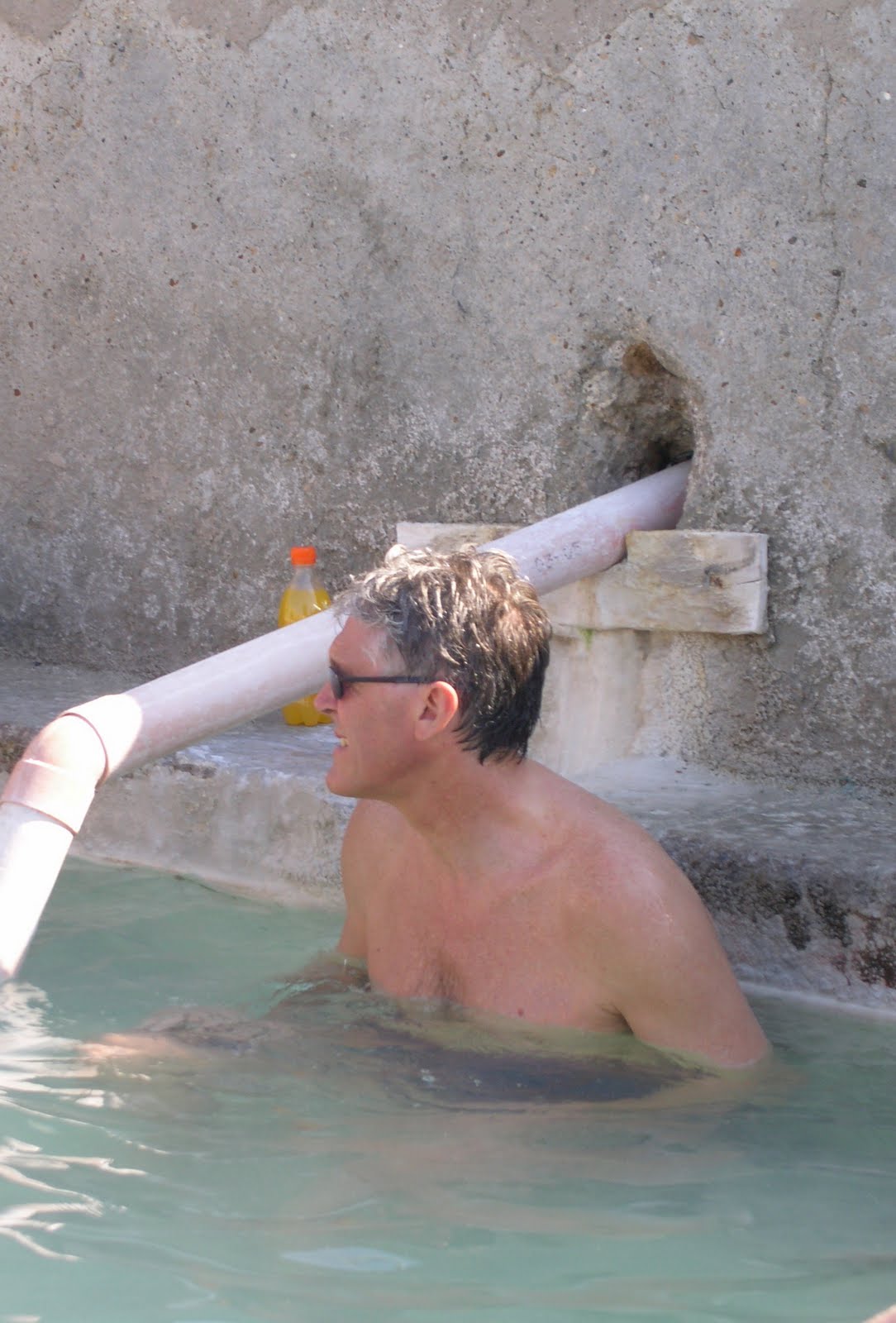
My husband and I dropped off our son at the Fiumicino airport at 7:45 and headed north to the hot thermal waters of “La Ficoncella” outside of Civitavecchia, named for the large fig tree that stands at its center. We were worried that it wouldn’t be open yet but there were already quite a few people “taking of the waters”, a mixture of locals and overnight campers. While the nearby Terme di Saturnia are elegant and expensive, this little spot costs .52 euro a car and .52 euro a person (the old 1,000 lire). In terms of creature comforts you get what you pay for (like the hospital), but the water is the same (like the surgeons).
 While soaking away ski injuries and cellulite with our fellow bathers -- many of whom could have stepped out of Fellini / Sordi films -- we learned that the Roman emperor, Trajan, sent his soldiers here to cure their battle wounds while the upper class soaked in the marble lined baths nearby (now the archeological site of the Terme di Taurine.) In the place of battle wounds, we met a 30-something Italian soaking his numerous motocross injuries (including a recent head trauma and coma) -- driving about four hours from Cretara with his camper for a weekend. Even the orthopedic surgeon for the Rome soccer team sends players here to recover -- must be pretty special water indeed.
The grounds had been privately owned before WWII but were subsequently bequeathed to the people (cittadini) NOT the city (comune) of Civitavecchia. It had been run by volunteers for some time (lots of discussion about how many years) before being taken over by a cooperativa that still runs the bar, parking lot and takes care of cleaning the tubs, one each day. A homemade rustic affair -- no massages, facials, mud baths and such, just the curative effects of timeless water.
In Italy, history runs along just below the surface, bubbling up into every aspect of life. The motocross driver, Trajan’s soldiers back from battle and I all enjoyed the same ancient stream. The past and the present. The future can wait.
A domani,
E
Subscribe to:
Posts (Atom)

 Posts
Posts

