A friend just sent me this link to an NPR (National Public Radio)interview with the author of a new book called, The Geography of Bliss. In this book, Eric Weiner seeks out places in the world where people are reportedly the happiest -- and looks for the reasons why. I was intrigued, especially after a recent Italian survey that revealed an 80% "happiness rate", despite a rather negative take on the economy, personal safety and politics (see this post).
One particularly happy country was Switzerland: things work well, the trains run on time, the streets are clean. But more importantly, they vote seven or eight times a year in public referendum, and they have a say in what happens in their life. He says that they also make an effort to hide their extraordinary wealth, so as not to provoke envy in others -- a great enemy of happiness.
On the other side of the world, he met a man in Bhutan who told him that, "you need to set aside a few minutes a day to think about death" in order to live a happy life. (On this note, I would suggest my book clubs recent selection, Everyman by Philip Roth)
What did he finally learn at the end of his travels in search of happiness? That, when all is said and done, happiness isn't personal, but relational. Exactly what our Italian survey discovered! Despite all the problems, woes, lack of faith in the system or the future, 80% of those interviewed said that they led basically happy lives....with close ties to their family and friends.
Thanks Gillian!
a domani,
E
Showing posts with label family. Show all posts
Showing posts with label family. Show all posts
January 15, 2008


January 3, 2008
Hope for 2008
Between December 17 and 19, La Repubblica newspaper engaged the Demos-Eurisko company to organize and conduct a survey of 1000 Italians representative of the adult population on the state of their lives. It turns out that Italians define themselves as "angry" (as has been discussed quite a bit these past few months among local expat bloggers following Bebbe Grillo's "VaFa" day). But beyond this anger and although Italians are unsatisfied with the economy, worried about personal safety and unhappy about politics, over 80% declared themselves to be happy with their lives.
How do they do it?
Family and friends. While Rome burns, Italians huddle up at home with their family or hang out in the piazza with their friends. That's all it takes to achieve a modest degree of happiness, and they even figured it out without resorting to endless shelves of self-help books -- the upside of a relationship-based society. The word Italians chose to best describe their feelings toward the future was "hope" (speranza). Where does that come from if not from their personal lives, as they are pretty negative about everything else.
If family and friends don't quite fill the gap, there is always hope to be found in sports -- nearly 75% of Italians surveyed believe that the Ferrari will win the Formula-1 championship, 66% are sure that the Italian national soccer team will win the European championship and 62% have faith that Valentino Rossi will win the world motorcycle racing title.
When asked, "What does Italy need to improve itself in the next year?" the number one response was, "More young people in places of power" with "Improve the schools and university" close behind.
So, despite the Italian "malessere" amply described in a recent New York Times article, there is room for hope and maybe this new sense of anger will set in motion change for the future.
a domani,
E
How do they do it?
Family and friends. While Rome burns, Italians huddle up at home with their family or hang out in the piazza with their friends. That's all it takes to achieve a modest degree of happiness, and they even figured it out without resorting to endless shelves of self-help books -- the upside of a relationship-based society. The word Italians chose to best describe their feelings toward the future was "hope" (speranza). Where does that come from if not from their personal lives, as they are pretty negative about everything else.
If family and friends don't quite fill the gap, there is always hope to be found in sports -- nearly 75% of Italians surveyed believe that the Ferrari will win the Formula-1 championship, 66% are sure that the Italian national soccer team will win the European championship and 62% have faith that Valentino Rossi will win the world motorcycle racing title.
When asked, "What does Italy need to improve itself in the next year?" the number one response was, "More young people in places of power" with "Improve the schools and university" close behind.
So, despite the Italian "malessere" amply described in a recent New York Times article, there is room for hope and maybe this new sense of anger will set in motion change for the future.
a domani,
E
October 7, 2007
What he left behind
Big Luciano has left us, and lots of lawyers and accountants are at work sorting out what he left behind -- an estate of dimensions that are still to be quantified. The big question is what to do about his very last will in which he asks that all his US holdings be placed into an existing trust -- a complication to the inheritance question.
He leaves an ex-wife (out of the picture by now), three grown children by his first marriage, a second wife (Nicoletta) and their young child (five-year old Alice). By Italian civil law, at least half of the total inheritance must be left to the children in equal amounts and the other half to the wife. The US does not have such pre-set percentages, Granddad Hilton is threatening to disown his wild granddaughter Paris and cut her out of his will -- not possible under Italian law.
The power of the family, just as Luigi Barzini described it 40 years ago, still stands, also because of inheritance laws. You are born into a family and you always remain a part of this legal entity. Even if its members fight bitterly, don't speak for years, lose touch or whatever, the family stands as a island onto itself, forever, as a unit of survival which passes on power, wealth, prestige, connections, positions in addition to DNA.
The family is at the center of the "in-group" cultural imperative. You are BORN into groups to which you belong and can never leave, just like your family. We, instead, choose to join groups, as an individual, and leave them when we like, just like we move out from our families at 18 and choose whether to remain a tight-knit group or not.
a domani,
E
He leaves an ex-wife (out of the picture by now), three grown children by his first marriage, a second wife (Nicoletta) and their young child (five-year old Alice). By Italian civil law, at least half of the total inheritance must be left to the children in equal amounts and the other half to the wife. The US does not have such pre-set percentages, Granddad Hilton is threatening to disown his wild granddaughter Paris and cut her out of his will -- not possible under Italian law.
The power of the family, just as Luigi Barzini described it 40 years ago, still stands, also because of inheritance laws. You are born into a family and you always remain a part of this legal entity. Even if its members fight bitterly, don't speak for years, lose touch or whatever, the family stands as a island onto itself, forever, as a unit of survival which passes on power, wealth, prestige, connections, positions in addition to DNA.
The family is at the center of the "in-group" cultural imperative. You are BORN into groups to which you belong and can never leave, just like your family. We, instead, choose to join groups, as an individual, and leave them when we like, just like we move out from our families at 18 and choose whether to remain a tight-knit group or not.
a domani,
E
September 21, 2007
Divorce and all that
It is very difficult to objectively and lovingly examine one’s own culture. Luigi Barzini is the only Italian that has done it successfully, while adding wit, historical background and journalistic accuracy.
His book, The Italians, published in 1964, is still the only true examination of Italian culture that exists today. If you are thinking of moving to Italy, you already have or are just interested in the Italians as a people, this is the book to read.
He made one big mistake, though, near the end of the chapter, Power of the Family. “Divorce is beginning to be adopted as an upper-class custom. Of course there is still no divorce on the law books, and there never will be. Not only is the Church against it, but the people themselves rightly consider it a barbarous and ruinous institution; the necessity to preserve some solid bulwark against the impermanence of things will always prevent its adoption.”
Instead, only eight years later, divorce came to be -- despite the war waged by the Catholic church -- by “furore del popolo” and a public referendum.
Between 1995 and 2005, separations have gone from 51,000 to 83,000, divorces from 27,000 to 47,000. Although Italy doesn’t come close to European standards, or American ones in which 50% of marriages end in divorce before reaching 25 years, separations have become more democratic. They no longer involve only the upper class, which means that more couples that separate end up in poverty.
With an Italian twist. In a country where the family supplies “welfare” instead of the state, one in five separated men go back home, to their parents' home – the only way to afford alimony and a another roof over their head – and yet another example of intra-generational solidarity and family ties. Luigi Barzini was right – “The first source of power is the family. The Italian family is a stronghold in a hostile land: within its walls and among its members, the individual finds consolation, help, advice, provisions, loans, weapons, allies and accomplices to aid him in his pursuits. No Italian who has a family is ever alone.”
A domani,
E
His book, The Italians, published in 1964, is still the only true examination of Italian culture that exists today. If you are thinking of moving to Italy, you already have or are just interested in the Italians as a people, this is the book to read.
He made one big mistake, though, near the end of the chapter, Power of the Family. “Divorce is beginning to be adopted as an upper-class custom. Of course there is still no divorce on the law books, and there never will be. Not only is the Church against it, but the people themselves rightly consider it a barbarous and ruinous institution; the necessity to preserve some solid bulwark against the impermanence of things will always prevent its adoption.”
Instead, only eight years later, divorce came to be -- despite the war waged by the Catholic church -- by “furore del popolo” and a public referendum.
Between 1995 and 2005, separations have gone from 51,000 to 83,000, divorces from 27,000 to 47,000. Although Italy doesn’t come close to European standards, or American ones in which 50% of marriages end in divorce before reaching 25 years, separations have become more democratic. They no longer involve only the upper class, which means that more couples that separate end up in poverty.
With an Italian twist. In a country where the family supplies “welfare” instead of the state, one in five separated men go back home, to their parents' home – the only way to afford alimony and a another roof over their head – and yet another example of intra-generational solidarity and family ties. Luigi Barzini was right – “The first source of power is the family. The Italian family is a stronghold in a hostile land: within its walls and among its members, the individual finds consolation, help, advice, provisions, loans, weapons, allies and accomplices to aid him in his pursuits. No Italian who has a family is ever alone.”
A domani,
E
May 27, 2007
Election day
 Tomorrow is election day for the local administration in Sabaudia and it showed -- posters with faces and slogans for the various candidates lined the streets. example: "se lo vuoi onesto, scegliere Ernesto." As we passed one large poster for a certain named Antonio, my husband exclaimed, "look at the guy, he is practically saying,"elect me so that I can take care of my cousin's land rights, my uncles legal problems and make a bunch of money for myself." He concluded that none of these candidates had any interest in the town and the people in it. A rant.
Then we got to the beach, our stabilimento, and I chatted with Titti, who basically said the same thing. I didn't respond -- best not to get involved in these rants as an outsider.
Not much faith in local politicians here, I can only suppose for good reason. I asked Salvatore, the stabilimento owner, why he didn't run for office and he shook his head, "and mix with all those thieves and no good scum..." He is not even going to vote.
So who is going to run the show?
a domani,
E
May 2, 2007
Primo Maggio a Trento
Greetings from Trento.
I guess my cultural moment for the day is the odd inclusive feeling I am having as I intrude on my 19 year-old son's life. Over the past few days, we have been out to dinner one evening, an ice cream another and several walks about town -- all with one or more of his friends, meeting up off on as kids do. He is fine with having me hang around and so are his friends. They may leave me off before continuing the evening, but no one feels uncomfortable. Although this just may be a personal thing, I think that there is an "Italian family" component that leads to a different process for becoming independent.
In the meantime, I shall just enjoy my last day.
One note on "il primo maggio" that celebrates the worker. Like all non-Catholic holiudays, this one is also often full of tensions -- the relationship of the worker and society as both change over time. This has always been a day full of demonstrations on one side and concerts in the piazza on the other (to appease the masses).
Our "labor day" is instead a celebration of "work" not "the worker" -- the difference is subtle, but significant.
a domani,
E
I guess my cultural moment for the day is the odd inclusive feeling I am having as I intrude on my 19 year-old son's life. Over the past few days, we have been out to dinner one evening, an ice cream another and several walks about town -- all with one or more of his friends, meeting up off on as kids do. He is fine with having me hang around and so are his friends. They may leave me off before continuing the evening, but no one feels uncomfortable. Although this just may be a personal thing, I think that there is an "Italian family" component that leads to a different process for becoming independent.
In the meantime, I shall just enjoy my last day.
One note on "il primo maggio" that celebrates the worker. Like all non-Catholic holiudays, this one is also often full of tensions -- the relationship of the worker and society as both change over time. This has always been a day full of demonstrations on one side and concerts in the piazza on the other (to appease the masses).
Our "labor day" is instead a celebration of "work" not "the worker" -- the difference is subtle, but significant.
a domani,
E
April 21, 2007
The Families Who Made Rome
Last night, I had the pleasure of attending Anthony Majanlahti’s presentation of his book, The Families Who Made Rome: A History and a Guide, in the Throne Room of the Palazzo Doria Pamphilj just behind Piazza Venezia sponsored by the Canadian Women’s Association of Rome, the Canadian Embassy to the Holy See and kindly hosted by the Doria Pamphilj family. He was witty and told lots of interesting stories, about the noble and papal families who built Rome between the 13th to the 18th century, both literally through what they built and socially through why they chose to build what they did and how.
The Families Who Made Rome – a book with a theme that often pops up in my blog as I look at Italian culture today – families and their particular nature in Italy. The book delves back eight centuries to look at how these families were and follows them up to the 18th century.
There was violence – like today, they regularly commit murder among themselves, there was greed and power, sometimes lots of power when the family had a pope to call its own, and an amazing dose of self-esteem or arrogance that drove their lives and family dynasties. They enjoyed a good show and making a spectacle -- one prince even blew up a few building instead of quietly tearing them down to make space for a piazza by his palazzo, he simply liked the idea of homemade fireworks lighting up the sky, a good show indeed, until the debris descended. They formed family style corporations and, as one line died out, intermarried to ensure future generations. Family as a business – not much has changed on this side as well.
They were concerned with how they presented themselves and used the family “griffe” to impose their personal style on the city through palazzi, churches, fountains and gardens. They even lived in clusters, all the family in one block of palazzo or quite close by – staking out their corner of the city.
The book is a good read, a combination of history and a guide book that leads you around the city by family, what they built and why, instead of by street names. It also provides insight into some characteristics of today’s Italians – how they came to be the way they are, the families that formed and passed on through generations, an Italian style of thinking, being and doing.
A domani,
E
The Families Who Made Rome – a book with a theme that often pops up in my blog as I look at Italian culture today – families and their particular nature in Italy. The book delves back eight centuries to look at how these families were and follows them up to the 18th century.
There was violence – like today, they regularly commit murder among themselves, there was greed and power, sometimes lots of power when the family had a pope to call its own, and an amazing dose of self-esteem or arrogance that drove their lives and family dynasties. They enjoyed a good show and making a spectacle -- one prince even blew up a few building instead of quietly tearing them down to make space for a piazza by his palazzo, he simply liked the idea of homemade fireworks lighting up the sky, a good show indeed, until the debris descended. They formed family style corporations and, as one line died out, intermarried to ensure future generations. Family as a business – not much has changed on this side as well.
They were concerned with how they presented themselves and used the family “griffe” to impose their personal style on the city through palazzi, churches, fountains and gardens. They even lived in clusters, all the family in one block of palazzo or quite close by – staking out their corner of the city.
The book is a good read, a combination of history and a guide book that leads you around the city by family, what they built and why, instead of by street names. It also provides insight into some characteristics of today’s Italians – how they came to be the way they are, the families that formed and passed on through generations, an Italian style of thinking, being and doing.
A domani,
E
April 17, 2007
The Murder Divide
Italians have their own home-grown types of violence and murder – from the family-style Sicilian mafia to the ideological madness of the Red Brigades. They also have a certain propensity to kill family members when life overwhelms, generally starting with the mother-in-law before moving on to wife, children, brothers and sisters -- a recent shooting even expanded to include the next door neighbors. But the random shooting of strangers in a public place (a school, mall, office, fast food restaurant) is a foreign concept that is generally associated with the US.
I am sure that over the next few days I will be asked many times why these terrible mass shootings take place on American soil. I certainly don’t have any answers, but perhaps I can come up with a few questions. Could it have to do with the sense of alienation that comes hand in hand with a culture based on the individual? If the individual is the basic unit of survival and self-reliance and independence are core values, what happens when you feel backed up against the wall and alone, who do you turn to, where do you go? It is you against the world, as an individual, alone. Instead, if the family is the basic unit of survival, and interdependence and mutual reliance are core values, do you take your family along with you, killing them, then yourself because in any case, they can't survive without you? To each culture, its murder madness.
A domani,
E
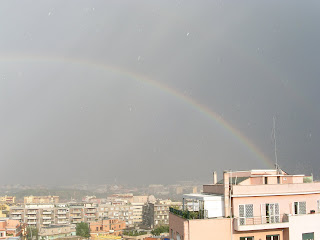
As I was writing, a sudden (and violent) afternoon storm came through, leaving this gift to share.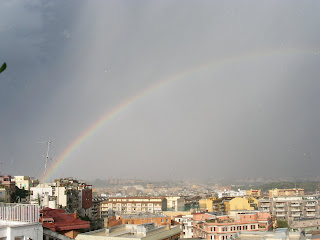
I am sure that over the next few days I will be asked many times why these terrible mass shootings take place on American soil. I certainly don’t have any answers, but perhaps I can come up with a few questions. Could it have to do with the sense of alienation that comes hand in hand with a culture based on the individual? If the individual is the basic unit of survival and self-reliance and independence are core values, what happens when you feel backed up against the wall and alone, who do you turn to, where do you go? It is you against the world, as an individual, alone. Instead, if the family is the basic unit of survival, and interdependence and mutual reliance are core values, do you take your family along with you, killing them, then yourself because in any case, they can't survive without you? To each culture, its murder madness.
A domani,
E
As I was writing, a sudden (and violent) afternoon storm came through, leaving this gift to share.


April 3, 2007
The family business
Yesterday’s La Repubblica newspaper had its usual Monday Business and Finance supplement, with its usual story about a woman in carriera (a successful businesswoman) on the front page. I think I have heard it before. Yawn. She is smart (only female graduating member of her class in engineering), savvy (papa sent her abroad to study and learn languages), young (31), very driven, determined and capable.
She went to work for the family business just out of university, covering many areas before taking over the company’s marketing, research and development. She does not feel herself to be “the daughter of” and has no complexes of any sort. She never felt the need to rebel, her father had sent her abroad to study and had always trusted her, in fact she had asked him if she could enter into the family firm, not the other way around. She learned the business from the bottom up while always being given every opportunity to do so. In fact, it was the Managing Director who took her out of internal accounting and gave her the task of “reinventing our marketing” although she had no experience or studies in the field. “I started from zero, went to the library and studied.”
Whew. She had certainly been groomed and was up to the challenge. Being figlia di is often a self-fulfilling prophecy. A question of faith and trust and living up to expectations. We Americans have a problem with this -- the self-made man, pulling yourself up from nowhere by your bootstraps are the stuff of Americans. Slipping into the family business is the coward's route that does not show “independence” and “self-reliance.” But, at the same time, she is good, really good and really dedicated. She states, “My only objective is the good of the company.” Now where would you find that sentiment outside of the family?
A domani,
E
She went to work for the family business just out of university, covering many areas before taking over the company’s marketing, research and development. She does not feel herself to be “the daughter of” and has no complexes of any sort. She never felt the need to rebel, her father had sent her abroad to study and had always trusted her, in fact she had asked him if she could enter into the family firm, not the other way around. She learned the business from the bottom up while always being given every opportunity to do so. In fact, it was the Managing Director who took her out of internal accounting and gave her the task of “reinventing our marketing” although she had no experience or studies in the field. “I started from zero, went to the library and studied.”
Whew. She had certainly been groomed and was up to the challenge. Being figlia di is often a self-fulfilling prophecy. A question of faith and trust and living up to expectations. We Americans have a problem with this -- the self-made man, pulling yourself up from nowhere by your bootstraps are the stuff of Americans. Slipping into the family business is the coward's route that does not show “independence” and “self-reliance.” But, at the same time, she is good, really good and really dedicated. She states, “My only objective is the good of the company.” Now where would you find that sentiment outside of the family?
A domani,
E
March 16, 2007
One square kilometer
Today I overheard a conversation between two friends. One needs to move to a larger apartment, her son is turning 12 and he needs to have a room of his own instead of the couch in the living room. She and her husband had just visited a perfect two bedroom / two bath apartment with a reasonable price, terrace, parking place. What’s the catch? Her mother now lives down the street, a 5-10 minute walk. This other apartment would be instead a 10-15 minute drive – much too far away. How would she manage when her son is sick, or if her mother just wants to stop by and help out?
I have seen figures that range from 80-90% of Italians that live within one square kilometer of their parents. They help each other out, up and down the generational scale, like Renzo and Anna. The smallest unit of Italian survival is the family, and it is best to have its members close by. From the figures above, most Italians do not feel their individuality and independence as adults threatened by having their parents next door, downstairs or just around the corner. How many of you expats out there moved to be near your parents-in-law? How many of your US friends would do the same? Our smallest unit of survival is ourselves, as individuals, and at the end of the day, we both seek out and are affirmed by our self-reliance.
A domani,
E
I have seen figures that range from 80-90% of Italians that live within one square kilometer of their parents. They help each other out, up and down the generational scale, like Renzo and Anna. The smallest unit of Italian survival is the family, and it is best to have its members close by. From the figures above, most Italians do not feel their individuality and independence as adults threatened by having their parents next door, downstairs or just around the corner. How many of you expats out there moved to be near your parents-in-law? How many of your US friends would do the same? Our smallest unit of survival is ourselves, as individuals, and at the end of the day, we both seek out and are affirmed by our self-reliance.
A domani,
E
March 13, 2007
Ravioli with computer
I am back from a week up north -- a combination of family and fun, too much of both to be caught online!
On Sunday, we passed through Verona for lunch with my PMIL at a lovely restaurant* near the casa di Giulietta where we enjoyed exquisite homemade pastas to start, fish dishes on next, some local white wine and espresso to round it off. The place was full of Veronese families on Sunday outings, a post-baptism festa downstairs (a boy judging from the blue ribbons lining the stairs) and a few tourists – two American women with a small child.
“Oh no” I thought as they settled in at the table next to ours, but the three-year-old made no fuss or noise, nor did he whine, run around or roll about under the table as his mother and friend dined on pasta and fagioli and pumpkin ravioli respectively, salads and sweets. I peeked over my PMIL’s shoulders and saw the reason why: he was on his knees with his elbows on the table and eyes transfixed on a small Sony computer. He was in another world, that of the screen. He didn’t even drink the glass of milk his mother had ordered and ate only a pack of gummy bears, groping for the bag and distractedly popping them one by one into his mouth.

Mega reverse cultural moment! I didn’t like this American cultural assimilation process. The boy was learning that meals are not necessarily a time and place for social interaction. He did not have to deal with other people, converse, listen, be bored and watch the walls, fidget and be reprimanded for doing so. Instead it was OK for him to be off in another virtual world instead of participating in the one around him. I have never seen an Italian mother allow a child that luxury at the table.
Lunch with the family in a public place is a painfully slow and tiresome experience for small children where they learn the importance of interdependence -- their inevitable and irrevocable roles in the family. When they get older, they cannot opt out of family dinner by grazing through the kitchen on their way out the door or holing up in their rooms with a nuked burrito. Family meals must be reckoned with and even enjoyed, even in adolescence. Meals in the company of others, at the table is still a cultural imperative, for Italians, not for the little blond three-year-old passing through Verona. He will choose to be a part of family meals or not, as he wishes, at his choice, as he did in Verona where his mother taught him that it is OK not to participate, if it is not to his convenience and desire.
a domani,
E
*Ristorante Greppia
Vicolo Samaritana, 3
tel+39 045 8004577
closed on Mondays
On Sunday, we passed through Verona for lunch with my PMIL at a lovely restaurant* near the casa di Giulietta where we enjoyed exquisite homemade pastas to start, fish dishes on next, some local white wine and espresso to round it off. The place was full of Veronese families on Sunday outings, a post-baptism festa downstairs (a boy judging from the blue ribbons lining the stairs) and a few tourists – two American women with a small child.
“Oh no” I thought as they settled in at the table next to ours, but the three-year-old made no fuss or noise, nor did he whine, run around or roll about under the table as his mother and friend dined on pasta and fagioli and pumpkin ravioli respectively, salads and sweets. I peeked over my PMIL’s shoulders and saw the reason why: he was on his knees with his elbows on the table and eyes transfixed on a small Sony computer. He was in another world, that of the screen. He didn’t even drink the glass of milk his mother had ordered and ate only a pack of gummy bears, groping for the bag and distractedly popping them one by one into his mouth.

Mega reverse cultural moment! I didn’t like this American cultural assimilation process. The boy was learning that meals are not necessarily a time and place for social interaction. He did not have to deal with other people, converse, listen, be bored and watch the walls, fidget and be reprimanded for doing so. Instead it was OK for him to be off in another virtual world instead of participating in the one around him. I have never seen an Italian mother allow a child that luxury at the table.
Lunch with the family in a public place is a painfully slow and tiresome experience for small children where they learn the importance of interdependence -- their inevitable and irrevocable roles in the family. When they get older, they cannot opt out of family dinner by grazing through the kitchen on their way out the door or holing up in their rooms with a nuked burrito. Family meals must be reckoned with and even enjoyed, even in adolescence. Meals in the company of others, at the table is still a cultural imperative, for Italians, not for the little blond three-year-old passing through Verona. He will choose to be a part of family meals or not, as he wishes, at his choice, as he did in Verona where his mother taught him that it is OK not to participate, if it is not to his convenience and desire.
a domani,
E
*Ristorante Greppia
Vicolo Samaritana, 3
tel+39 045 8004577
closed on Mondays
February 12, 2007
Independence and family
I have a particular Italian family (PIF) starting at the top with a particular Italian mother-in-law (PMIL) who I stopped to visit in Verona yesterday. From the beginning we have never had a typical Italian mother-in-law -- daughter-in-law relationship. She had been terrorized by her MIL and had sworn that she would not do the same. For the rest, I play deaf and don’t pick up on any interference that conveniently falls outside my radar -- being foreign does have its advantages.
But family is family, and the Italian one has its own particular cultural make-up. The fundamental Italian unit of survival is clearly not the individual but the family and the web of relationships and reciprocal obligations that tie its members to each other make for different concepts of the individual, and consequently what independence means and how it is achieved.
Americans find it very difficult to view the very Italian cultural concept of independence coming about within the family (instead of away from it) as a valid way to become a mature adult. We tend to put on our inherent cultural blinders when viewing very different cultural reality.
While recently raising adolescents, I was surprised and uncomfortable at how my Italian peers let their children have so much freedom to explore while my American friends (mainly New England suburban moms) set curfews, hand out chores and use any available means to send their children the message that they should move out at 18 if they wanted to have some freedom. As parents we feel uncomfortable being accomplices to the experimentation process, we see its proper place off somewhere in college, out of our sight. I slowly learned to envy Italian parents who can stand by and let it all happen under their noses without feeling like they have to interfere, while actually enjoying the spectacle!
In the end, independence is more a psychological than physical state and appearances can be deceiving.
I love watching adults with their adult parents that have moved on from the parent / child relationship to establish new and mature ones. Maybe the Italian route to independence while staying within the family leaves more room for all family members to mature, create new relationships and finally achieve a new and different family balance.
A domani from Trento,
E
But family is family, and the Italian one has its own particular cultural make-up. The fundamental Italian unit of survival is clearly not the individual but the family and the web of relationships and reciprocal obligations that tie its members to each other make for different concepts of the individual, and consequently what independence means and how it is achieved.
Americans find it very difficult to view the very Italian cultural concept of independence coming about within the family (instead of away from it) as a valid way to become a mature adult. We tend to put on our inherent cultural blinders when viewing very different cultural reality.
While recently raising adolescents, I was surprised and uncomfortable at how my Italian peers let their children have so much freedom to explore while my American friends (mainly New England suburban moms) set curfews, hand out chores and use any available means to send their children the message that they should move out at 18 if they wanted to have some freedom. As parents we feel uncomfortable being accomplices to the experimentation process, we see its proper place off somewhere in college, out of our sight. I slowly learned to envy Italian parents who can stand by and let it all happen under their noses without feeling like they have to interfere, while actually enjoying the spectacle!
In the end, independence is more a psychological than physical state and appearances can be deceiving.
I love watching adults with their adult parents that have moved on from the parent / child relationship to establish new and mature ones. Maybe the Italian route to independence while staying within the family leaves more room for all family members to mature, create new relationships and finally achieve a new and different family balance.
A domani from Trento,
E
January 28, 2007
Yours or mine
Today I would like to introduce you to another Elizabeth, a character in the short story Pets* who is having a cultural moment. The italics on the side are my running commentary.
Elizabeth is Canadian and a new arrival in Rome together with her husband and young daughter. She is talking to her friend at the pet shop. He runs the shop with his mother who has announced that she is going to retire and hand it over to his uncle.
“But if it’s your shop, just say no.” (seems to her that this would be the obvious plan of action, direct, to the point)
“Yes, it’s my shop. But my mother owns it.” (seems to him that obviously the question is more complicated. Oh course he would have just said no if that had been possible.)
“So it’s her shop. She’s the owner.” (she seeks clarification, simplicity, direct, clear relationships, and measurable facts)
“No, its mine. But she is the legal owner.” (he seeks a way to navigate unclear waters. There is history here lurking beneath the facts, and that history makes the facts more ambiguous.)
She concludes, “There was clearly some cultural nuance that I was failing to grasp, so I let it drop.”
Sounds like a good idea. She can think about it later and, after peeling off a few layers of the onion, find interesting new ways to see and understand the concept of ownership.
(*by Megan K. Williams in her short story collection, Saving Rome).
A domani,
E
Elizabeth is Canadian and a new arrival in Rome together with her husband and young daughter. She is talking to her friend at the pet shop. He runs the shop with his mother who has announced that she is going to retire and hand it over to his uncle.
“But if it’s your shop, just say no.” (seems to her that this would be the obvious plan of action, direct, to the point)
“Yes, it’s my shop. But my mother owns it.” (seems to him that obviously the question is more complicated. Oh course he would have just said no if that had been possible.)
“So it’s her shop. She’s the owner.” (she seeks clarification, simplicity, direct, clear relationships, and measurable facts)
“No, its mine. But she is the legal owner.” (he seeks a way to navigate unclear waters. There is history here lurking beneath the facts, and that history makes the facts more ambiguous.)
She concludes, “There was clearly some cultural nuance that I was failing to grasp, so I let it drop.”
Sounds like a good idea. She can think about it later and, after peeling off a few layers of the onion, find interesting new ways to see and understand the concept of ownership.
(*by Megan K. Williams in her short story collection, Saving Rome).
A domani,
E
January 17, 2007
Nonni -- the highest wrung on the Italian family ladder
Renzo and Anna are part of a slowly diminishing species – real Italian nonni. When I stopped by their apartment this afternoon, Renzo had just come in from taking his 89 year old mother-in-law to the hairdresser. While laying his magic hands (a gift of pranotherapy) on my son’s inflamed shoulder, he greeted his 3 ½ year old granddaughter as she wandered in from her post-nursery nap. Then he rushed back out with us to pick up his 10 year old grandson from school. Meanwhile nonna had taken care of lunch and was busy preparing snacks. This is their retirement. Shouldn’t they be off on cruise ships touring the seven seas, or having fun, relaxing and doing whatever they want to do? Instead, this is what they want to do.
The Italian family taking care of itself – the generation above and two below, quite a handful. My grandparents lived three states away and came around on Thanksgiving or Christmas, never both. Then we would visit them for a few days here and there while passing through on our way south.
At the beginning of her book, Mother Tongue: An American Life in Italy, author Wallis Wilde-Menozzi tells of moving to Parma with her Italian husband whom she had met, lived with, and married in California. Somehow things were different back in his hometown of Parma, “If we had moved to another Italian city, if we had defined ourselves outside of Paolo’s family and customs” she wistfully wonders….. What she hadn’t counted on was that once back home, he couldn’t define himself outside of his family. He is Italian and although we also define ourselves within the context of our families, our American smallest unit of survival is clearly, deeply and singularly, the individual, ourselves. An Italian’s smallest unit of survival is enlarged to include his or her family. It is a very basic and astoundingly profound difference that reverberates in wider and wider circles to encompass many aspects of daily life. Not a matter of personal choice, but rather a cultural given.
a domani,
E
The Italian family taking care of itself – the generation above and two below, quite a handful. My grandparents lived three states away and came around on Thanksgiving or Christmas, never both. Then we would visit them for a few days here and there while passing through on our way south.
At the beginning of her book, Mother Tongue: An American Life in Italy, author Wallis Wilde-Menozzi tells of moving to Parma with her Italian husband whom she had met, lived with, and married in California. Somehow things were different back in his hometown of Parma, “If we had moved to another Italian city, if we had defined ourselves outside of Paolo’s family and customs” she wistfully wonders….. What she hadn’t counted on was that once back home, he couldn’t define himself outside of his family. He is Italian and although we also define ourselves within the context of our families, our American smallest unit of survival is clearly, deeply and singularly, the individual, ourselves. An Italian’s smallest unit of survival is enlarged to include his or her family. It is a very basic and astoundingly profound difference that reverberates in wider and wider circles to encompass many aspects of daily life. Not a matter of personal choice, but rather a cultural given.
a domani,
E
January 2, 2007
New Years lunch
Four eighteen year old boys came and went – my son and three friends of his visiting from Trento. In the meantime I haven’t been able to get to my computer through the sleeping bags on the floor in our upstairs study.
After returning home in the not-so-wee hours on New Years day, they slept until nearly 1:00. On awakening and after a quick coffee and a shower, they were ready for IL PRANZO. The guests kindly asked if they could help set the table, cut the bread and such, but they were clearly expecting a sit down, full three course lunch. I knew that, and after a morning run to clear my head from the midnight champagne, I had gotten down to business and I was at a good point – fave beans cooked and run through the food processor, sliced bread set out for grilling, salad ready for dressing, cheese and coldcut platter nicely arranged. They hovered and watched (after two days they no longer worried about what an American mother would possibly serve). Finally everyone converged on the table, sitting poised while I served the crema di fave with lightly boiled shrimp, oil and crostini.
Over an hour later, we had finished. The boys helped clean up the table before they headed out for another round of their Roman adventure, full and satisfied, down to the leftover panettone and coffee.
The pleasant part was sitting at the table with my husband and all this adolescent exuberance in sheer harmony. They described their New Years eve (well, at least part of it), the people they had met and the things they had seen in Rome, talked about school and the upcoming maturità exams, described quirky teachers, and generally conversed with the adults – naturally, leisurely and at ease.
No rush! ‘E l’ora del pranzo.
While American kids struggle to define themselves as INDIVIDUALS, separate from their family and part of a society based on individualism, the Italian kids seem to be comfortable in the nucleus of a family environment – no need to break free to become an individual when you can evolve and grow and become independent within the family.
Happy New Year!
A domani,
E
After returning home in the not-so-wee hours on New Years day, they slept until nearly 1:00. On awakening and after a quick coffee and a shower, they were ready for IL PRANZO. The guests kindly asked if they could help set the table, cut the bread and such, but they were clearly expecting a sit down, full three course lunch. I knew that, and after a morning run to clear my head from the midnight champagne, I had gotten down to business and I was at a good point – fave beans cooked and run through the food processor, sliced bread set out for grilling, salad ready for dressing, cheese and coldcut platter nicely arranged. They hovered and watched (after two days they no longer worried about what an American mother would possibly serve). Finally everyone converged on the table, sitting poised while I served the crema di fave with lightly boiled shrimp, oil and crostini.
Over an hour later, we had finished. The boys helped clean up the table before they headed out for another round of their Roman adventure, full and satisfied, down to the leftover panettone and coffee.
The pleasant part was sitting at the table with my husband and all this adolescent exuberance in sheer harmony. They described their New Years eve (well, at least part of it), the people they had met and the things they had seen in Rome, talked about school and the upcoming maturità exams, described quirky teachers, and generally conversed with the adults – naturally, leisurely and at ease.
No rush! ‘E l’ora del pranzo.
While American kids struggle to define themselves as INDIVIDUALS, separate from their family and part of a society based on individualism, the Italian kids seem to be comfortable in the nucleus of a family environment – no need to break free to become an individual when you can evolve and grow and become independent within the family.
Happy New Year!
A domani,
E
Subscribe to:
Posts (Atom)

 Posts
Posts

